SPXT - AGD: Fully Covering Distribution, But Increasing Domestic Exposure
2025-01-19 04:26:29 ET
Summary
- The abrdn Global Dynamic Dividend Fund offers a high yield of 12.94%, making it attractive for income-seeking investors amidst inflation concerns.
- The fund has a considerably higher yield than most of its peers, but the distribution was fully covered in the most recent year.
- The fund's increasing exposure to U.S. equities is a questionable decision given high domestic valuations and lower yields than available abroad.
- The fund does appear to be underweight U.S. technology, however, so it is not investing too heavily in companies with the most egregious valuations.
- Currently trading at a 7.19% discount to NAV, the fund is more expensive than its historical average and peers, suggesting potential for better entry points.
The abrdn Global Dynamic Dividend Fund ( AGD ) is a closed-end fund that income-seeking investors can purchase as a way of achieving a high level of current income from the assets that they already possess. As with its sister fund, the abrdn Total Dynamic Dividend Fund ( AOD ), this fund invests primarily in equity securities. As regular readers likely know, I consider this to be an advantage right now as it seems likely that inflation will continue to be a problem going forward.
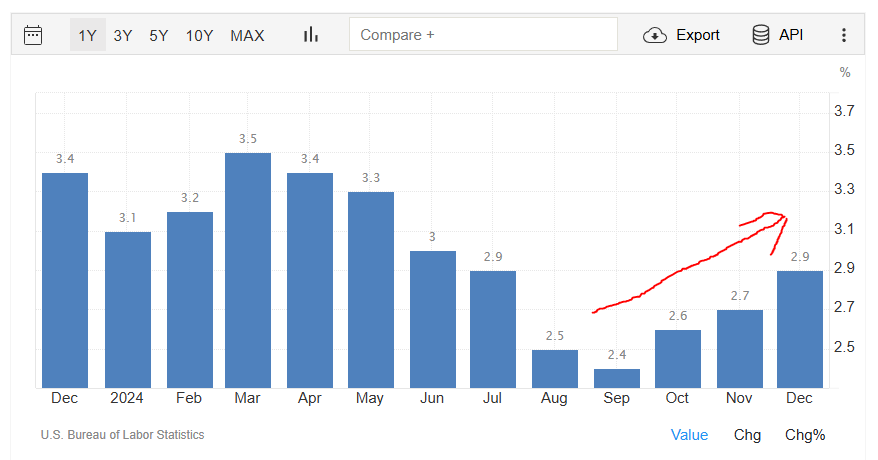
This conclusion is supported by recent data, which clearly shows the headline inflation rate starting to increase immediately following the September interest rate cuts:
Furthermore, the most recent Budget and Economic Outlook released by the Congressional Budget Office strengthens the case for further inflation. To summarize, the Congressional Budget Office predicts a federal deficit of $1.9 trillion in 2025 that will grow over time to $2.7 trillion by 2035. The national debt (and especially the nominal value of outstanding U.S. Treasury debt) is projected to grow at a faster pace than gross domestic product over the period, which by itself is inflationary. In addition, the report makes it clear that the underlying assumption (derived from the average federal funds rate of 3.2%) is that the interest rate on the ten-year U.S. Treasury will be around 3.8% over the period. That is well below today’s 4.63% ten-year U.S. Treasury yield, which implies very strong demand for U.S. Treasury debt internationally. As I pointed out in a recent article , recent U.S. Treasury auctions have been very disappointing, and international investors are already showing a marked lack of interest in financing the United States debt. That, therefore, leaves the question of who will purchase all of the new Treasury debt to push yields down permanently. The only answer that I can come up with is that the Federal Reserve will be forced to intervene in the bond market and engage in permanent quantitative easing, purchasing the U.S. debt issuance itself with newly printed money. As we saw back in 2021, that is highly inflationary. Thus, investors should take steps to preserve the purchasing power of their wealth given this outlook. One way to do that is to favor global equity funds over fixed-income securities. The fact that we have global equity funds such as the abrdn Global Dividend Fund with yields comparable to the best fixed-income funds makes this an easy task for investors in search of income....
AGD: Fully Covering Distribution, But Increasing Domestic Exposure