RAK:CC - Rackla Metals Outlines 2025 Exploration Plans for the Grad Property in Northwest Territories
(TheNewswire)
Vancouver, British Columbia – February 25, 2025 – TheNewswire - RacklaMetals Inc. (TSX-V: RAK) (the “Company ”)is pleased to provide an update on the exploration plans for the Grad Property in the Northwest Territories (NWT). The Grad Propertyis located in the eastern portion of the Tombstone Gold Belt and wasstaked in July of 2024 when the land came open following more than adecade of land use planning. Prior to Rackla staking the claims therewas no history of exploration on the intrusion at the core of theProperty. The 2024 program was limited to 10 days on the property andconsisted of prospecting, rock, stream sediment and talus-finesampling, an airborne geophysical survey and a photogrammetry survey.Rackla is exceedingly pleased with the results from the 2024program.
Grad Property 2024 explorationhighlights:
New Gold Discovery – BiTeZone: Talus-fine sampling at the southern marginof the North Nahanni Pluton returned a broad zone of quartz-tourmalineand quartz-sulfide veining, with grades up to 92 g/t Au.
Large Gold Anomaly: A 550m-wide anomaly averaging 1.06 g/t Au, with a core zoneof 180m averaging 3.68 g/t Au.
Extensive Mineralization: Channel sampling at the base of the cliff returned 38mgrading 1.8 g/t Au, with strong indications that the mineralizationextends up the 450m ridge.
Strong GeochemicalIndicators: High concentrations of bismuth andtellurium, which are key pathfinders for Reduced Intrusive RelatedGold Systems (RIRGS).
Significant ExpansionPotential: Early results suggest the mineralizedsystem extends at least 1.3 km north of BiTe, with strong gold,bismuth, tellurium, and tungsten values.
2025 Exploration Program: Initial drilling to test the BiTe Zone at the base of thecliff and additional mapping and channel sampling to delineate themineralized zone along strike.
CEO Simon Ridgway stated, “The early results from theBiTe Zone at the Grad Property are highly encouraging and point to thepotential for a significant gold system. The combination of high-gradegold values, strong geochemical signatures, and widespread alterationsuggests we’ve just begun to uncover the full extent of thisdiscovery. We’re eager to build on these early successes with afocused 2025 program that will take our understanding of the system tothe next level.”
The Grad Property
The Grad Property is centered on the North Nahanni Pluton , a Cretaceous-aged, Mayo Suite felsic intrusion in theeastern Tombstone Gold Belt in the NWT. Thepluton measures 1.9 by 2.2 km with a sizable, intensely altered,contact aureole expressed as hornfelsed and iron-stained gossanoussediments surrounding the intrusion.
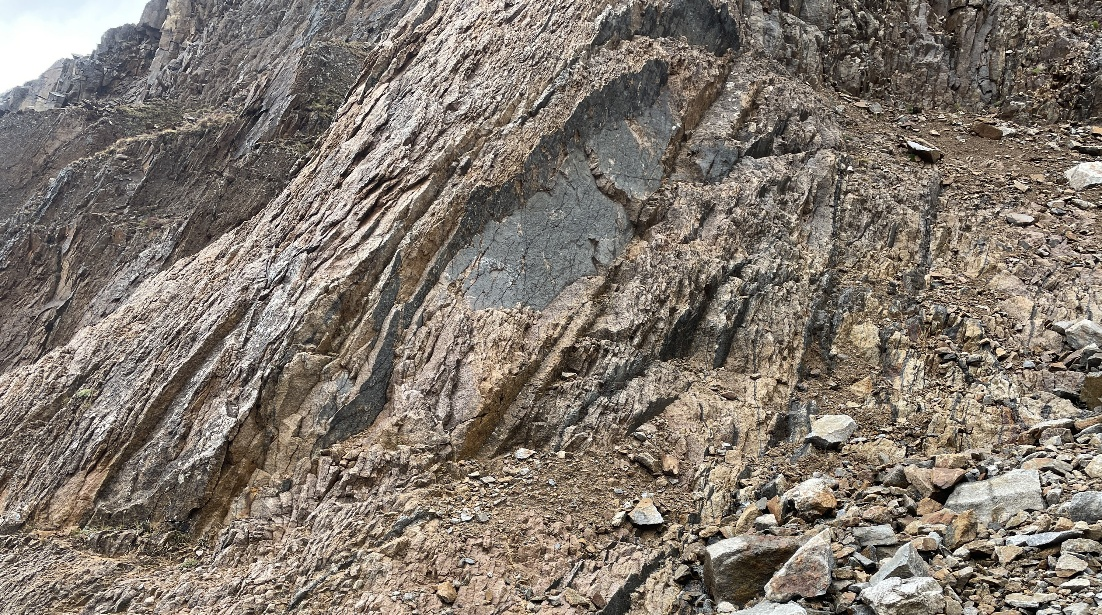
While conducting talus sampling at the southern marginof the Pluton, a broad alteration zone was identified with intensequartz-tourmaline and quartz-sulfide veining within the intrusive, theintensity of the veining shattering the intrusive body to almost aschistose appearance. Results of the sampling returned significantgold grades, up to 92 g/t Au, with many samples returning multi-gramgold. The gold mineralization is associated with bismuth, tellurium+/- tungsten confirming that this is a Reduced Intrusive Related GoldSystem (RIRGS). The discovery was named the BiTe Zone.
Figure 1 – Photograph of theshattered North Nahanni Pluton:
The BiTe Zone is defined by a talus-fine sample linethat returned 550 m with an average gold concentration in the samplesof 1.06 g/t Au. Within that interval is a central core of 180 m thataveraged 3.68 g/t Au. The intensity of the core alteration zoneappears to extend up the face of the cliff to the ridge top which is450 m along strike and 350 m vertically above the discovery. While nosamples have been taken to date above the base of the cliff, a channelsample of 40 m in length taken at the base of the cliff across thevein orientation returned 38 m grading 1.8 g/t Au. The concentrationof bismuth and tellurium from rock samples collected on the GradProperty is in an order of magnitude higher than anything Rackla hasobserved in the eastern part of the Tombstone Gold Belt during theCompany’s 2+ years of exploration in the region, hence the name ofthe zone (BiTe).
The geochemical signature of the BiTe Zone isindicative of a robust RIRGS system. The Au-Bi-Te-W metal assemblageis an important characteristic of RIRGS deposits ( 1 Hart, 2007).The Bismuth concentration in rock samples is up to 2.17% fromhigh-grade gold samples at BiTe (with 92.4 g/t Au, 1250 ppm Te, and260 ppm W) and up to 2.98% from a sample collected 1.3 km north ofBiTe (with 2.8 g/t Au, 23 ppm Te, and 0.66% W). The results show astrong correlation of gold to tellurium and bismuth with correlationcoefficients of 0.878 and 0.578, respectively.
Figure 2 – Photograph of BiTe Zone with talus-fine, rock andchannel sample gold results:
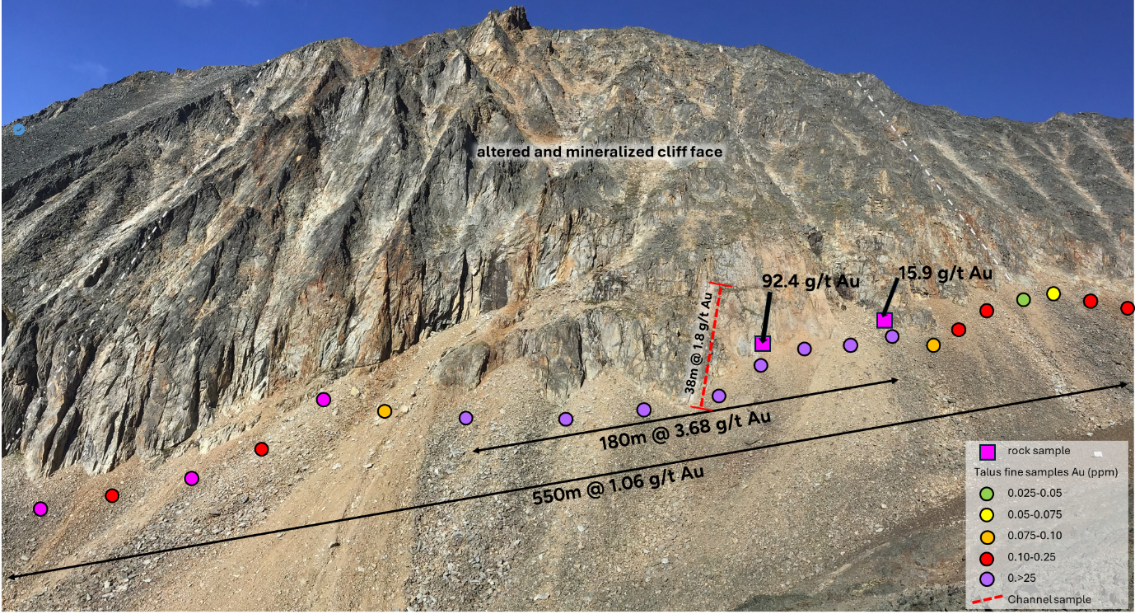
These results are particularly encouraging consideringthe limited field program in 2024 and the magnitude of the BiTe targethas plenty of room for expansion.
Figure 3 – Plan view of the NorthNahanni Pluton on the Grad Property with dimensions of the alterationand mineralizing system:
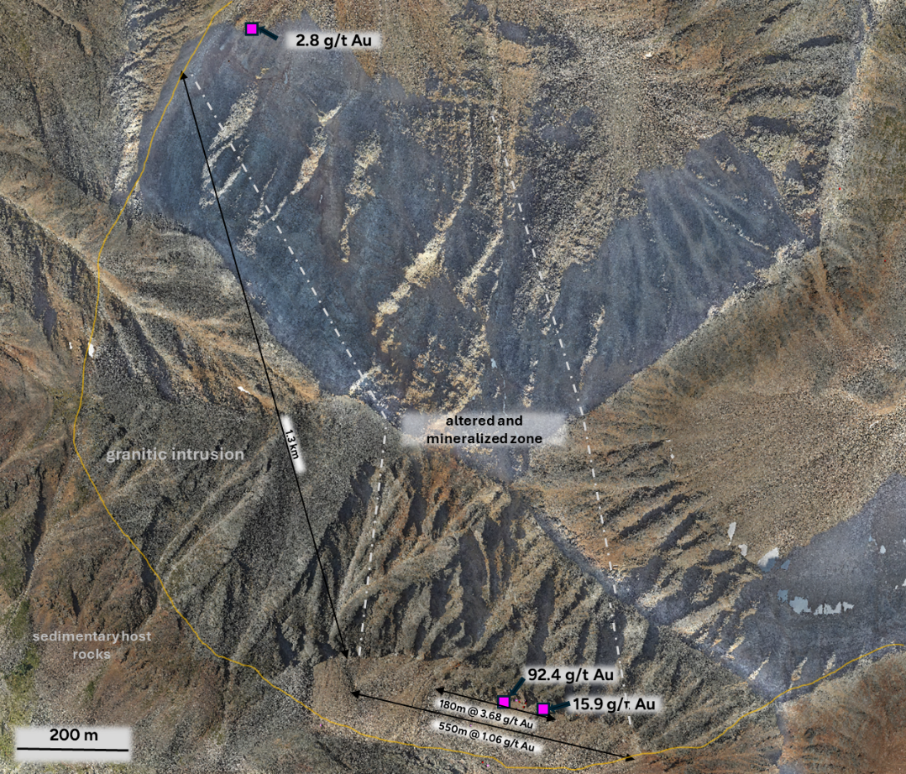
The cliff above BiTe is a steep face that rises 400 mfrom the valley floor and exhibits many of the features observed atthe BiTe Zone: abundant sheeted quartz-sulphide veining; intensefracture pattern; and strong iron oxide staining from the weatheringof sulphide minerals. As mentioned above, the talus-fine anomaly atBiTe is 550 m wide. The photogrammetry image shows that the alterationand mineralizing system strikes for 1.3 km to the north, whereprospecting has returned a sample with 2.8 g/t Au, 2.98% Bi, 23 ppm Teand 0.66% W.
Only a small portion of the property has beenprospected, yet these results confirm the potential for significantextension to the mineralization identified at the BiTe Zone.
The 2025 exploration program will focus on getting adrill turning at the discovery outcrop at the base of the cliff. Theprogram will also involve sampling the upper reaches of the cliff faceon both sides of the ridge using a mountaineering geological team,preparing drill pads along the ridge top and delineating the extent ofthe mineralized zone on the north side of the ridge with detailedstructural mapping and channel sampling.
1 Hart, C.J.R., 2007, Reducedintrusion-related gold systems, in Goodfellow, W.D., ed., Mineraldeposits of Canada: A Synthesis of Major Deposit Types, DistrictMetallogeny, the Evolution of Geological Provinces, and ExplorationMethods: Geological Association of Canada, Mineral Deposits Division,Special Publication No. 5, p. 95-112.
Qualified Person
Scott Casselman, B.Sc., P.Geo., Vice-PresidentExploration of the Company, is a member of the Association ofProfessional Engineers and Geoscientists of British Columbia and isthe Company’s Qualified Person as defined by National Instrument43-101. Mr. Casselman has reviewed and approved the technicalinformation contained in this news release.
AboutRackla
Rackla Metals Inc. (TSX-V: RAK) is a Vancouver, Canadabased junior gold exploration company. The Company is targetingReduced Intrusion-Related Gold Systems (RIRGS) mineralization on thesoutheastern part of the Tombstone Gold Belt in eastern Yukon andwestern Northwest Territories. Management believes that this area,which is underexplored for RIRGS deposit types, has the potential tobe the next frontier for the discovery of these large goldsystems.
ON BEHALF OF THE BOARD
Simon Ridgway,
CEO and Director
Tel: (604) 8 01-5432; Fax: (604)662-8829
Email: info@goldgroup.com
Website: www.racklametals.com
Neither the TSX Venture Exchange norits Regulation Services Provider (as that term is defined in thepolicies of the TSX Venture Exchange) accept responsibility for theadequacy or accuracy of this news release.
Forward-Looking Information
Certain statements contained in thisnews release constitute forward-looking statements within the meaningof Canadian securities legislation. All statements included herein,other than statements of historical fact, are forward- lookingstatements and include, without limitation, the Company’s futureexploration activities; and general business and economic conditions.Often, but not always, these forward looking statements can beidentified by the use of words such as “estimate”,“estimates”, “estimated”, “potential”, “open”,“future”, “assumed”, “projected”, “used”,“detailed”, “has been”, “gain”, “upgraded”,“offset”, “limited”, “contained”, “reflecting”,“containing”, “remaining”, “to be”, “periodically”, orstatements that events, “could” or “should” occur or beachieved and similar expressions, including negativevariations.
Forward-looking statements involveknown and unknown risks, uncertainties and other factors which maycause the actual results, performance or achievements of the Companyto be materially different from any results, performance orachievements expressed or implied by forward-looking statements. Suchuncertainties and factors include, among others, changes in generaleconomic conditions and financial markets; the Company or any jointventure partner not having the financial ability to meet itsexploration and development goals; risks associated with the resultsof exploration and development activities, estimation of mineralresources and the geology, grade and continuity of mineral deposits;unanticipated costs and expenses; and such other risks detailed fromtime to time in the Company’s quarterly and annual filings withsecurities regulators and available under the Company’s profile onSEDAR+ at www.sedarplus.ca .Although the Company has attempted to identify important factors thatcould cause actual actions, events or results to differ materiallyfrom those described in forward-looking statements, there may be otherfactors that cause actions, events or results to differ from thoseanticipated, estimated or intended.
Forward-looking statements containedherein are based on the assumptions, beliefs, expectations andopinions of management, including but not limited to: that theCompany’s stated goals and planned exploration activities at itsproperties will be achieved; that there will be no material adversechange affecting the Company, its properties or its securities; andsuch other assumptions as set out herein. Forward-looking statementsare made as of the date hereof and the Company disclaims anyobligation to update any forward-looking statements, whether as aresult of new information, future events or results or otherwise,except as required by law. There can be no assurance thatforward-looking statements will prove to be accurate, as actualresults and future events could differ materially from thoseanticipated in such statements. Accordingly, investors should notplace undue reliance on forward-looking statements.
Copyright (c) 2025 TheNewswire - All rights reserved.