






Initial Drilling at Coyote Basin Shows Radioactivity Correlating to Historical Drilling
MWN-AI** Summary
Homeland Uranium Corp., based in Vancouver, British Columbia, has announced significant findings from the initial drilling phase at its fully owned Coyote Basin Uranium Project, as part of a larger Phase II exploration program. The company recently completed the first six out of 35 planned reverse circulation drill holes, covering approximately 5,300 meters. These initial drill sites were strategically positioned to target areas identified in previous drilling efforts and a mapping campaign conducted in June 2025.
The results from downhole spectral gamma ray readings have shown elevated near-surface radioactivity within the key mineralized horizons, correlating with findings from historic drilling conducted in 1979. Particularly notable were readings from drill hole CB-RC-0023, which detected multiple zones of increased radioactivity at depths between 220 and 320 meters, indicating potential for additional uranium mineralization. The radioactivity was found to be widely dispersed within various geological formations, suggesting further exploration could yield additional resources.
The press release underscores the need for chemical assays to validate the accuracy of spectral gamma readings, as uranium mineralization may not be in equilibrium with its decay products—a known issue in uranium exploration. As such, Homeland has collected samples for geochemical analysis to enhance the understanding of the mineralization.
While Homeland acknowledges the historical resource estimate of 8.85 million tons grading 0.20% U3O8 sourced from previous operators, it emphasizes that these figures should not be interpreted as current resources. A Qualified Person must conduct further evaluations before reclassifying or verifying these resources. The ongoing drilling and subsequent analyses will refine their geological model and enhance the characterization of uranium locations at Coyote Basin.
MWN-AI** Analysis
Homeland Uranium Corp. (TSXV: HLU) has recently announced significant developments at its Coyote Basin Uranium Project, particularly following the initial phase of a comprehensive drilling program. The completion of six Reverse Circulation (RC) drill holes has returned promising readings of elevated radioactivity, aligning with historical data from previous operators. This suggests a potential for significant uranium resources, reinforcing investor interest in the company.
The correlation between the current drilling results and past explorations is a positive indicator, providing a level of credibility to the ongoing project and emphasizing the importance of the geological structure at Coyote Basin. The recorded radioactivity between 50 and 100 meters depth, as well as additional zones identified deeper, underscores an opportunity for material resource expansion. Such developments can lead to increased market valuation as investors gauge the potential of newly confirmed mineralization.
Moreover, with the ongoing Phase II exploration involving detailed geochemical analysis, there is potential for refining the geological model, which can provide further clarity and assurance regarding uranium grades. However, it’s crucial to remain aware of uranium disequilibrium issues highlighted in the report; inconsistencies between radiometric readings and recorded assay values could affect investor sentiment.
For those considering entry into Homeland Uranium's stock, now may present a time of cautious optimism. The correlation between historical and current drilling results could offer substantial upside if further exploration substantiates the identified mineralization. Nevertheless, investors should maintain vigilance regarding the extensive analytical process still required before true uranium grades can be confirmed and additional capital needs for future drilling phases.
In summary, while the findings at Coyote Basin create a bullish narrative for Homeland Uranium, risks associated with exploration and assay accuracy warrant careful consideration. A watchful approach, monitoring forthcoming assay results, will be essential for informed investment decisions moving forward.
**MWN-AI Summary and Analysis is based on asking OpenAI to summarize and analyze this news release.
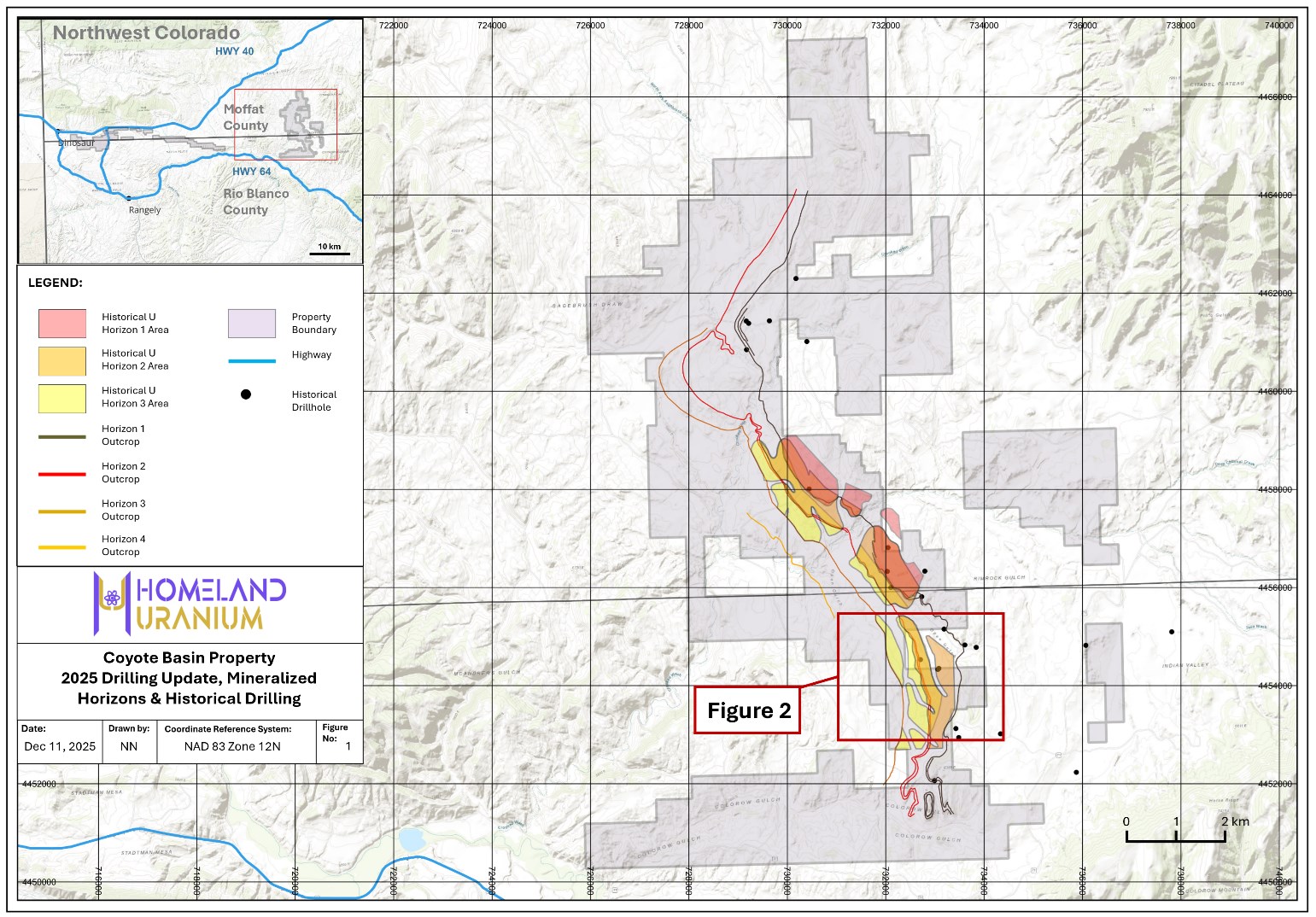
Vancouver, British Columbia--(Newsfile Corp. - December 15, 2025) - Homeland Uranium Corp. (TSXV: HLU) (OTCQB: HLUCF) (FSE: D3U) ("Homeland" or the "Company") is pleased to provide an update on Part 1 of the Phase II exploration program at the 100% owned Coyote Basin Uranium Project (the "Project") (Figure 1).
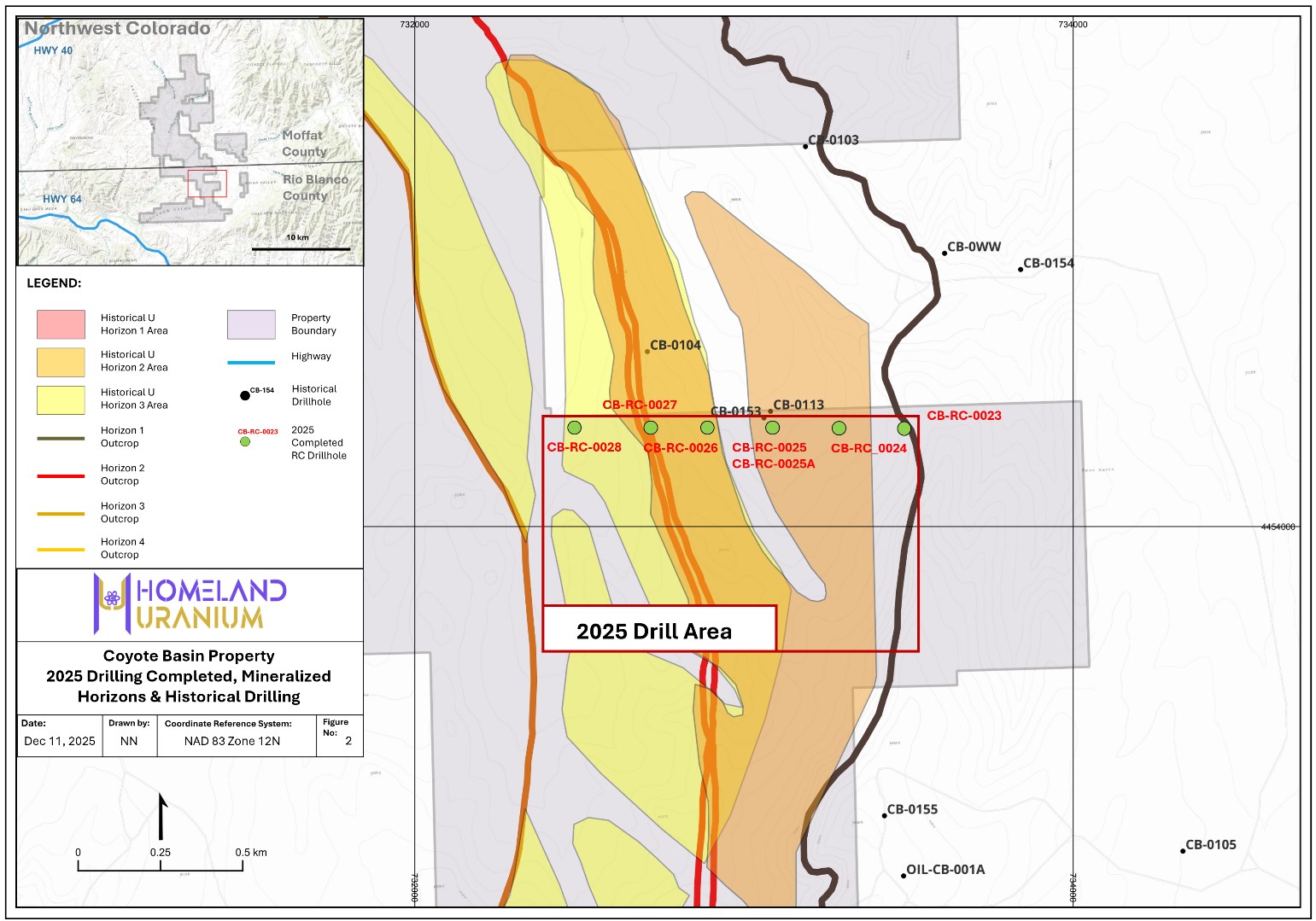
The first six of the planned 35 Reverse Circulation (RC) drillholes (Figure 2) have been completed as part of the Phase II exploration drilling program totaling approximately 5,300 m (17,000 ft). Drilling is focused on the key historical resource-bearing locations identified by previous operators and during the Company's June mapping and prospecting program. These first six holes were drilled on a single east-west oriented fence positioned at the northern end of the southern historical resource area defined by previous explorers (see Figure 2).
Downhole Spectral Gamma Ray CPS (Counts Per Second) readings obtained from the completed drill holes (CB-RC-0023 to CB-RC-0028) demonstrate near-surface elevated radioactivity (50 – 100 m depth) that correlates with the shallow mineralized horizons previously identified in historical 1979 drilling (Figure 2), interpreted to dip gently eastward at approximately 4 degrees.
Drilling in hole CB-RC-0023, the easternmost hole on the fence, also identified multiple zones of elevated radioactivity at depths between 220 and 320 metres (722 – 1050 ft) that remains open for expansion.
In addition to confirming the down-dip extensions of the known outcropping radioactivity, anomalous radioactivity is found to be widely dispersed within shales, claystones, and fine-grained sandstones within the Upper Member of the Fort Union Formation. These findings suggest that there is potential for additional uranium mineralization to exist between the known mineralized horizons.
It is not uncommon for uranium mineralization within sandstone-hosted uranium deposits to be in disequilibrium with the daughter products of the radioactive decay series (see the Quality Assurance/Quality Control section below). While downhole gamma logging is often an effective tool for defining radiometric horizons and correlating with historical drilling, it has been determined that chemical assays will be required before uranium grades can be accurately determined. Ongoing drilling and geochemical analysis will support refinement of the geological model and improved characterization of uranium mineralization.
Quality Assurance/Quality Control
All drillholes are radiometrically logged using a calibrated QL40 SGR Spectral Gamma Ray downhole probe, which collects continuous spectral gamma measurements along the length of the drillhole. Gamma value as Counts Per Second are collected. The probe response is calibrated using coefficients derived from the probe's most recent factory calibration and through comparison of probe responses to geochemical assay data from previously sampled intervals.
Spectral gamma tools measure natural radioactivity, and in situations where the uranium decay series is in equilibrium, such gamma readings can be converted into equivalent concentrations of uranium, thorium, and potassium. However, if the uranium decay series is not in equilibrium, conversion of spectral gamma into equivalent concentrations of uranium may not be accurate, a phenomena known as uranium disequilibrium. Uranium disequilibrium has been documented to occur at the nearby former producing Maybelle Uranium Mine, located approximately 29 km (18 miles) northeast of the Coyote Basin Project (see Global Uranium & Enrichment's news release dated July 30, 2025, which can be found at https://wcsecure.weblink.com.au/pdf/GUE/02972557.pdf).
As a first step in determining the accuracy of QL40 SGR Spectral Gamma Ray downhole probe and determining whether uranium disequilibrium may occur at Coyote Basin, Homeland's geological team used a portable hand-held XRF (SciAps X-555 REE Analyzer) to test drill cuttings for the presence of uranium. Enough discrepancies have occurred when comparing the results of the Spectral Gamma Ray downhole probe and the XRF that additional geochemical and assay sampling will be required before uranium grades can be accurately determined.
Homeland has collected samples from each 5 ft interval of the drill holes for geochemical analysis which will be sent to SGS Laboratories in Lakefield, Ontario. SGS Lab is certified ISO 17043: General requirements for proficiency testing. All SGS laboratories are required to participate in SGS's internal Proficiency Testing (PT) program: Laboratory Quality Systems International (LQSi) program, the largest PT program in the mining world. The SGS LQSi program currently involves over 100 laboratories on a regular basis, both SGS and non-SGS participants. SGS LQSi holds accreditation to the conformity assessment standard ISO 17043: General requirements for proficiency testing.
All depths and intervals reported are drilled depths and downhole lengths, unless otherwise stated. True thicknesses have not yet been determined.
About Homeland Uranium Corp.
Homeland Uranium is a mineral exploration company focused on becoming a premier US-focused and resource-bearing uranium explorer and developer. The Company is the 100% owner of the Coyote Basin and Cross Bones uranium projects in northwestern Colorado.
The Coyote Basin Project is reported by Energy Metals Corporation in its quarterly Management Discussion and Analysis dated September 30, 2006, filed with the Securities and Exchange Commission ("SEC") to contain an estimated historical resource of 8,850,000 tons grading 0.20% U3O8 and 0.10% V2O5 totaling 35.4 million pounds of U3O8 and 17.7 million pounds of V205 (see Energy Metal's SEC disclosure at https://www.sec.gov/Archives/edgar/data/1361605/000106299306003601/exhibit99-2.htm). This resource was calculated by the previous project operator, Western Mining Resources, based on a 1978-79 program of surface sampling, coring, drill hole chip sampling and gamma logging of 24 widely spaced holes (private internal report, Western Mining, Executive Summary, Coyote Basin Uranium District, Rio Blanco and Moffat Counties, State of Colorado, January, 1980).
The Company is not treating the Coyote Basin historical resource estimate as current mineral resources and the reader is cautioned not to rely on either of these estimates. A Qualified Person (as defined under National Instrument 43-101 – Standards of Disclosure for Mineral Projects ("NI 43-101")) has not done sufficient work to classify the historical resources from the project as current mineral resources or mineral reserves nor can the Company or the Qualified Person comment on the quality or verify the data obtained from the assay sampling programs from the project that were used to determine these historical resource estimates, as such information was not included in the historical reports acquired by Homeland. The Company is not treating the historical resource estimate as current mineral resources or mineral reserves and the Company and the Qualified Person is unable to compare the historical resource estimate to the CIM's current resource classification system at this time. The Coyote Basin Project any future NI 43-101 mineral resource estimate will require considerable further evaluation which will include completion of the Phase I drilling program and may require addition drilling to follow-up Phase 1 results.
Qualified Person
Nancy Normore., P.Geo., the Company's Vice President, Exploration, is a Qualified Person as defined in NI 43-101, and has reviewed and approved the technical content of this news release.
For further information, please contact:
Roger Lemaitre
President & Chief Executive Officer
Homeland Uranium Corp.
Tel: 306-713-1401
Email: info@homeland-uranium.com
Investor Relations
Kin Communications Inc.
Tel: 604-684-6730
Email: HLU@kincommunications.com
Neither the TSX Venture Exchange nor its Regulation Services Provider (as that term is defined in the policies of the TSX Venture Exchange) accepts responsibility for the adequacy or accuracy of this news release.
Figure 1 – Location of Homeland Uranium's Coyote Basin Project
To view an enhanced version of this graphic, please visit:
https://images.newsfilecorp.com/files/10583/278000_08dd42fd748b588f_002full.jpg
Figure 2 – Completed drillholes during Part 1 of Phase 2 - Coyote Basin Project
To view an enhanced version of this graphic, please visit:
https://images.newsfilecorp.com/files/10583/278000_08dd42fd748b588f_003full.jpg
To view the source version of this press release, please visit https://www.newsfilecorp.com/release/278000
FAQ**
How does Homeland Uranium Corp. plan to further explore the potential uranium mineralization identified at the Coyote Basin Project (HLUCF HLUCF) as indicated by downhole gamma readings?
What are the implications of uranium disequilibrium on the ?U308 concentrations at the Coyote Basin Project, and how will it affect future drilling analysis for HLUCF HLUCF?
Considering the historical resources at the Coyote Basin Project, what challenges does Homeland Uranium face in transitioning these resources to current mineral reserves (HLUCF HLUCF)?
How will the geochemical analysis by SGS Laboratories impact the geological model for the Coyote Basin Project and potential future development (HLUCF HLUCF)?
**MWN-AI FAQ is based on asking OpenAI questions about HLUCF (OTC: HLUCF).
NASDAQ: HLUCF
HLUCF Trading
3.5% G/L:
$0.2484 Last:
9,214 Volume:
$0.2445 Open: