

Standard Uranium Confirms Anomalous Uranium and High-Grade Rare Earth Element Mineralization up to 9.83% TREO* at Surface on the Rocas Project
MWN-AI** Summary
Standard Uranium Ltd. has recently announced promising assay results from its Rocas Uranium Project, located in Saskatchewan, Canada, confirming both anomalous uranium and significant high-grade rare earth element (REE) mineralization during their 2025 exploration program. The exploration activity, conducted under a three-year earn-in agreement with Collective Metals Inc., involved extensive surface mapping and sampling in late 2025, which led to the discovery of multiple areas exhibiting strong radioactivity.
Key findings include a newly identified pegmatite outcrop that returned assay results of up to 9.83% Total Rare Earth Element Oxides plus Yttrium (TREO*) and 0.016% U3O8. Additionally, uranium concentrations from surface samples were recorded between 0.007% and 0.409% U3O8. The company's technical team identified previously undocumented radioactive occurrences through scintillometer prospecting, further enhancing the project's exploration potential.
Looking ahead, Standard Uranium is set to commence its first diamond drill program in March 2026, aimed at exploring high-priority zones along a significant 7.5-kilometre conductive corridor associated with uranium and REE occurrences. Sean Hillacre, President and VP Exploration of Standard Uranium, expressed optimism about the results, indicating that these findings significantly enhance the mineral value of the project.
With its strategic location near the Athabasca Basin and positive surface assay outcomes, Rocas Project stands as a compelling prospect for future exploration and development, positioning Standard Uranium as a potential key player in the uranium and REE markets as global demand for these critical minerals continues to grow.
MWN-AI** Analysis
Standard Uranium Ltd.'s recent confirmation of anomalous uranium mineralization alongside high-grade rare earth element (REE) concentrations on its Rocas Project offers a compelling surface-level play for investors. The assay results, revealing up to 9.83% Total Rare Earth Element Oxides plus Yttrium (TREO) and promising uranium grades, underscore the project's potential to contribute significantly to the growing demand for critical minerals.
The announcement's timing aligns with a broader shift towards clean energy technologies, which utilize both uranium for nuclear power and REEs in advanced electronics and renewable energy solutions. These factors may position Standard Uranium favorably within the market, as governmental and industrial pushes for clean energy adoption increase.
Investors should focus on key drivers: First, the results from the ongoing exploration, including the inaugural diamond drill program set to commence in March 2026, will be pivotal in confirming the viability of surface findings and assessing the broader mineralization potential. The delineation of high-priority zones, structured around historical mineralization and new discoveries, strengthens investment confidence.
Second, the partnership with Collective Metals, under a three-year earn-in agreement, mitigates operational risks and aligns interests between companies, potentially enhancing project efficiency and resource allocation.
Given the volatile nature of commodity prices, particularly in the uranium and REE markets, investors must remain vigilant. It's critical to monitor uranium prices and demand forecasts. Additionally, the surrounding geopolitical climate may influence resource availability, impacting market dynamics.
As Standard Uranium continues to develop the Rocas Project, stakeholders should consider the evolving landscape for uranium and REEs. Investments may present substantial upside potential based on exploration success, coupled with rising global demand for these essential resources. Long-term investors who are optimistic about the clean energy transition may find this stock appealing as market conditions unfold.
**MWN-AI Summary and Analysis is based on asking OpenAI to summarize and analyze this news release.
Vancouver, British Columbia--(Newsfile Corp. - March 10, 2026) - Standard Uranium Ltd. (TSXV: STND) (OTCQB: STTDF) (FSE: 9SU0) ("Standard Uranium" or the "Company") is pleased to announce final assay results from its 2025 exploration program on the Rocas Uranium Project ("Rocas", or the "Project"), currently under a three-year earn-in option agreement with Collective Metals Inc. ("Collective") (CSE: COMT).
The Company completed a detailed mapping and sampling program across historical uranium showings and other zones of interest on the Project during the fall of 2025 (Figure 1). Multiple areas of strong radioactivity were identified, and assay results confirmed anomalous uranium mineralization across the Project. In addition, significant Rare Earth Element ("REE") mineralization was identified, with concentrations reaching high-grade? Total Rare Earth Element Oxides plus Yttrium ("TREO*") thresholds.
Highlights:
Uranium and High-Grade REE Mineralization at Surface: Significant REE mineralization grades associated with varying uranium concentrations of uranium hosted in outcrop and boulder grab samples has been confirmed across the Project, including a newly identified pegmatite outcrop with assay results up to 9.83% TREO* and 0.016% U?O? in grab sample. Uranium assays from outcrop and boulder grab samples range across the Project from 0.007% to 0.409% U?O?.
Discovery of New Radioactive Showings: Scintillometer prospecting conducted in the fall of 2025 uncovered previously undocumented radioactive occurrences across the Project in rock types favorable for uranium and REE mineralization.1
Ongoing Exploration: The inaugural diamond drill program at the Project is scheduled to commence in March 2026 and will begin testing high-priority zones along the main 7.5-kilometre magnetic low and EM conductive corridor, which coincides with gravity lows, cross-cutting structures, and several uranium and REE occurrences.
"The confirmation of high-grade Rare Earth Elements alongside uranium mineralization throughout the Rocas Project is a significant development that reveals substantial additional critical mineral value," said Sean Hillacre, President & VP Exploration of Standard Uranium, "These assay results are highly encouraging, and we've integrated this data into our targeting models as we finalize preparations for the first-ever diamond drill program on the property."
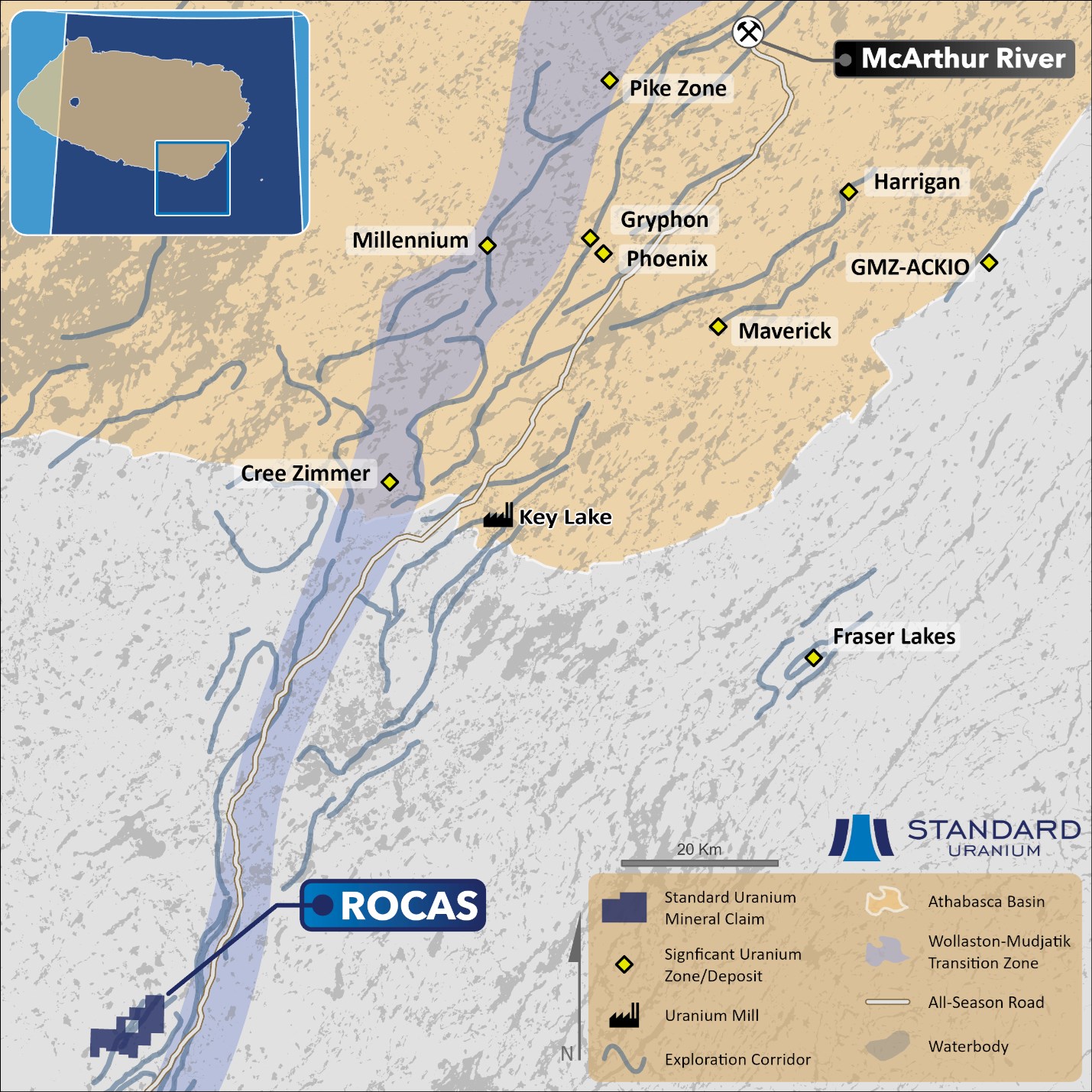
Figure 1. Regional map of the Rocas Project. The Project is located 75 kilometres southwest of the Key Lake Mine and Mill facilities along Highway 914.
To view an enhanced version of this graphic, please visit:
https://images.newsfilecorp.com/files/10633/287861_30454cb3b46559a7_001full.jpg
2025 Prospecting Program - Geochemical Assay Results
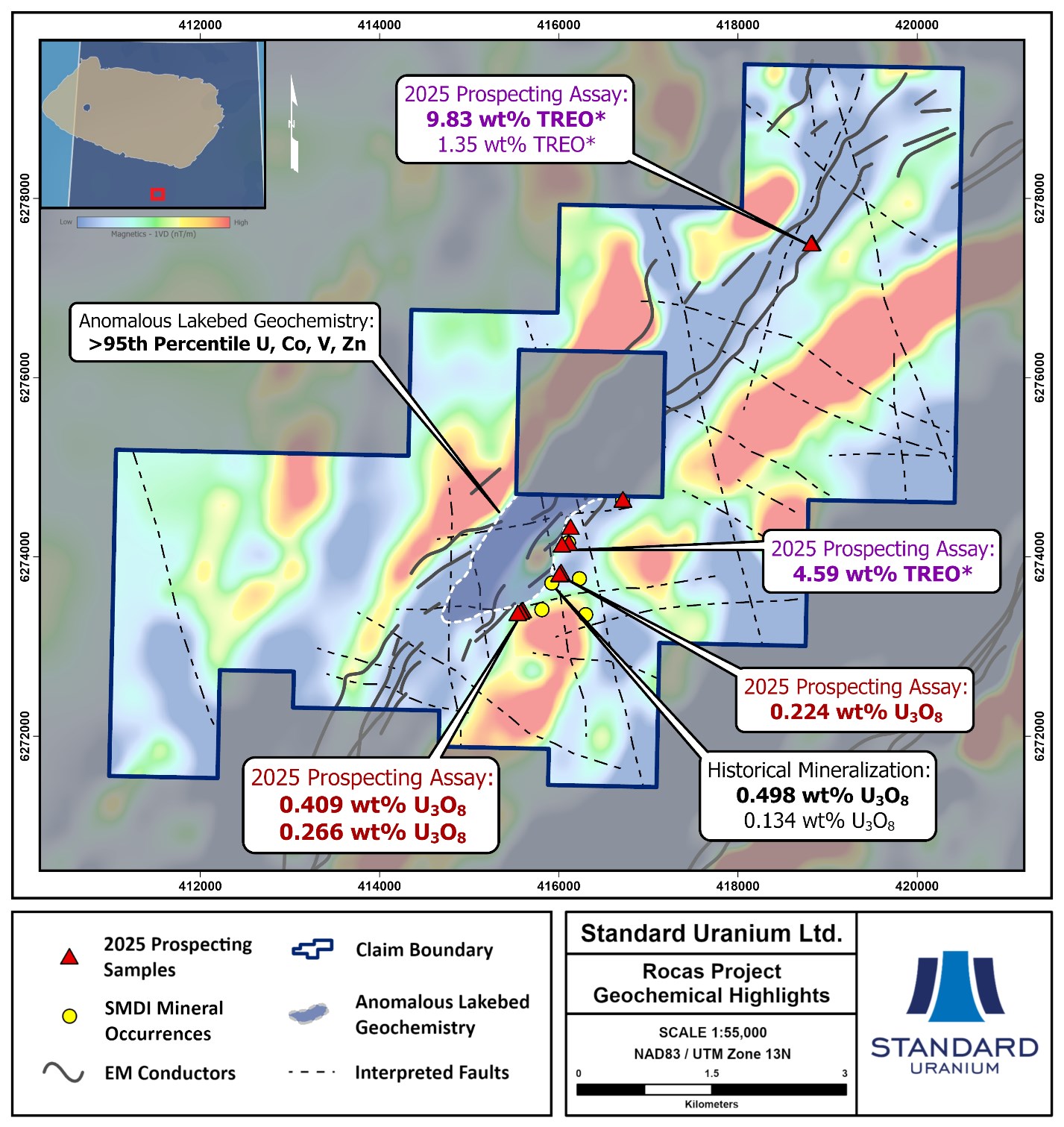
From September 30 to October 8, 2025, the Standard Uranium technical team completed a detailed mapping, prospecting, and sampling program to verify results from historical uranium showings at surface on the Project (Figure 2). Prospecting confirmed multiple uraniferous outcrops and boulders across the Project, including areas proximal to historical showing SMDI #5781 (0.195% and 0.054% U?O?).2 Uranium concentrations of up to 0.409% U?O? were obtained from outcrop exposures and boulder surface showings. In addition to discovering previously undocumented radioactive anomalies, the program confirmed significant REE mineralization on the Project in both outcrop and boulders, with several samples returning high grades exceeding 1.0% TREO* (Table 1).
A total of 16 outcrop and boulder grab samples were submitted to Saskatchewan Research Council Geoanalytical Laboratories ("SRC") in Saskatoon, SK - an ISO/IEC 17025:2017 and Standards Council of Canada certified analytical laboratory - for whole-rock, uranium, and REE geochemical analysis. Uranium and TREO* results from the 16 radioactive samples are summarized below in Table 1. Oxide TREO* values in Table 1 represent the total amount of rare earth element oxides in the lanthanide series plus the chemically similar element yttrium (Y?O?). Parts per million ("ppm") values were converted to oxide weight percent (wt.%) using the applicable conversion factor for each REE oxide and then summed.3
Table 1. Rocas 2025 Prospecting Uranium and TREO* Geochemical Assays
| Sample | Easting | Northing | Type | Uranium (partial, ppm) | U3O8 (wt.%) | TREO* (wt.%) |
| 244979 | 418828 | 6277517 | Outcrop | 15 | 0.007 | 1.354 |
| 244980 | 418817 | 6277511 | Outcrop | 313 | 0.016 | 9.833 |
| 244982 | 416008 | 6273824 | Outcrop | 1,150 | 0.133 | 0.056 |
| 245452 | 416111 | 6274171 | Outcrop | 1.88 | <0.001 | 0.977 |
| 245454 | 416715 | 6274656 | Outcrop | 1,670 | 0.195 | 0.085 |
| 245455 | 416131 | 6274349 | Outcrop | <1 | 0.007 | 1.129 |
| 245456 | 416716 | 6274650 | Outcrop | 447 | 0.054 | 0.066 |
| 244977 | 415588 | 6273417 | Boulder | 817 | 0.095 | 0.044 |
| 244978 | 415596 | 6273419 | Boulder | 1,010 | 0.135 | 0.061 |
| 244981 | 416011 | 6273821 | Boulder | 1,930 | 0.224 | 0.090 |
| 244983 | 415599 | 6273421 | Boulder | 1,960 | 0.218 | 0.066 |
| 244984 | 415577 | 6273410 | Boulder | 2,350 | 0.266 | 0.068 |
| 244985 | 415574 | 6273404 | Boulder | 1,000 | 0.112 | 0.109 |
| 244986 | 415542 | 6273389 | Boulder | 3,760 | 0.409 | 0.084 |
| 245451 | 416025 | 6273845 | Boulder | 261 | 0.033 | 0.055 |
| 245453 | 416035 | 6274153 | Boulder | 64 | 0.048 | 4.589 |
Figure 2. Geochemical Highlights from the 2025 Prospecting Program at the Rocas Project.
To view an enhanced version of this graphic, please visit:
https://images.newsfilecorp.com/files/10633/287861_30454cb3b46559a7_002full.jpg
Rocas 2026 Exploration
The Company recently announced plans to complete the first ever drill program on the Project in March 2026 to begin testing high-priority zones along the main 7.5 kilometre magnetic low/EM conductive corridor, which is host to several uranium showings and has remained un-drill tested to date.
In 2025, the Company contracted MWH Geo-Surveys (Canada) Ltd. to carry out a high-resolution ground gravity survey over the Rocas Project4, while Convolutions Geoscience Corporation has completed subsequent processing, interpretation, and modelling of the gravity data. The ground gravity survey identified several gravity low anomalies coincident with historical surface mineralization, lakebed geochemical anomalies, and cross-cutting fault zones along the known conductive exploration trends on the Project. Gravity lows in this geological setting are often associated with reduced rock density which may indicate alteration zones associated with uranium.
Airborne EM surveys conducted in 2017 defined conductive trends on the Project west of and sub-parallel to the Key Lake Road shear zone, corresponding with favourable metasedimentary basement lithologies. Multiple parallel conductors indicate structural widening of the trend, and offsets and termination points indicate important subsidiary cross-cutting structures. Additionally, a 2007 field sampling program identified lakebed geochemical anomalies that statistically rank as greater than 95th percentile U, Co, V, and Zn along the conductor corridor, including high U/Th ratios.5
The Company believes the Project is highly prospective for the discovery of shallow, high-grade* basement-hosted uranium mineralization. Positioned proximal to the margin of the Athabasca Basin, Rocas boasts shallow drill targets with bedrock under minimal glacial till cover. Historical mineralized outcrop grab samples along approximately 900 metres of strike length, returned values ranging from 587 ppm U (SN85073) up to 0.498 wt.% U3O8 (SN23901) and have never been drill tested.2
Qualified Person Statement
The scientific and technical information contained in this news release has been reviewed, verified, and approved by Sean Hillacre, P.Geo., President and VP Exploration of the Company and a "qualified person" as defined in NI 43-101 - Standards of Disclosure for Mineral Projects.
Samples collected for analysis were sent to SRC Geoanalytical Laboratories in Saskatoon, Saskatchewan for preparation, processing, and ICP-MS or ICP-OES multi-element analysis using total and partial digestion and boron by fusion. Radioactive samples were tested using the ICP-MS2 uranium multi-element exploration package plus boron. Samples chosen for REE analysis were tested using the REE2 package by ICP-MS. All samples marked as radioactive upon arrival to the lab were also analyzed using the U3O8 assay (reported in wt.%). SRC is an ISO/IEC 17025:2005 and Standards Council of Canada certified analytical laboratory. Blanks, standard reference materials, and repeats were inserted into the sample stream at regular intervals in accordance with Standard Uranium's quality assurance/quality control ("QA/QC") protocols. All samples passed internal QA/QC protocols and the results presented in this release are deemed complete, reliable, and repeatable.
REE oxide conversion factors3 were verified using the following formulas:
Convert REE (Rare Earth Element) ppm to REO (Rare Earth Oxide): REO % = (ppm / Atomic Weight of REE) * (Molecular Weight of REO / 10,000).
Element-to-oxide conversion factor: Molecular weight of the oxide / atomic weight of the element. For oxides with more than one metal cation, account for the number of cations in the formula.
Historical data disclosed in this news release relating to sampling results from previous operators are historical in nature. Neither the Company nor a qualified person has yet verified this data and therefore investors should not place undue reliance on such data. The Company's future exploration work may include verification of the data. The Company considers historical results to be relevant as an exploration guide and to assess the mineralization as well as economic potential of exploration projects. Any historical grab samples disclosed are selected samples and may not represent true underlying mineralization.
Natural gamma radiation from rocks reported in this news release was measured in counts per second ("cps") using a handheld RS-125 super-spectrometer and RS-120 super-scintillometer. Readers are cautioned that scintillometer readings are not uniformly or directly related to uranium grades of the rock sample measured and should be treated only as a preliminary indication of the presence of radioactive minerals. The RS-125 and RS-120 units supplied by Radiation Solutions Inc. ("RSI") have been calibrated on specially designed Test Pads by RSI. Standard Uranium maintains an internal QA/QC procedure for calibration and calculation of drift in radioactivity readings through three test pads containing known concentrations of radioactive minerals. Internal test pad radioactivity readings are known and regularly compared to readings measured by the handheld scintillometers for QA/QC purposes.
References
1 Standard Uranium Confirms Strong Radioactivity at Surface During Successful Exploration Program at the Rocas Uranium Project. https://standarduranium.ca/news-releases/standard-uranium-confirms-strong-radioactivity-at-surface-during-successful-exploration-program-at-the-rocas-uranium-project/
2 SMDI# 5781: https://mineraldeposits.saskatchewan.ca/Home/Viewdetails/5781 & Mineral Assessment Report MAW00726: Millenmin Ventures Inc. and Inner Mongolia Minerals (Canada) Ltd., 2013
4 Standard Uranium Acquires Umbra and Sable Uranium Projects and Completes Geophysical Surveys on Rocas and Atlantic Projects, Eastern Athabasca Basin, Saskatchewan. https://standarduranium.ca/news-releases/standard-uranium-acquires-umbra-and-sable-uranium-projects/
5 Mineral Assessment Report 74B09-0032: Forum Uranium Corp., 2007
*The Company considers uranium mineralization with concentrations greater than 1.0 wt.% U3O8 to be "high-grade".
**The Company considers radioactivity readings greater than 65,535 counts per second (cps) on a handheld RS-125 Super-Spectrometer to be "off-scale".
***The Company considers radioactivity readings greater than 300 counts per second (cps) on a handheld RS-125 Super-Spectrometer to be "anomalous".
?The Company considers REE mineralization with concentrations greater that 1.0 wt.% TREO* to be "high-grade".
About Standard Uranium (TSXV: STND)
We find the fuel to power a clean energy future
Standard Uranium is a uranium exploration company and emerging project generator poised for discovery in one of the world's premier uranium districts. The Company holds interest in over 241,652 acres (97,793 hectares) in the Athabasca Basin in Saskatchewan, Canada. Since its establishment, Standard Uranium has focused on the identification, acquisition, and exploration of Athabasca-style uranium targets with a view to discovery and future development.
Standard Uranium's Davidson River Project, in the southwest part of the Athabasca Basin, Saskatchewan, comprises ten mineral claims over 30,737 hectares. Davidson River is highly prospective for basement-hosted uranium deposits due to its location along trend from recent high-grade uranium discoveries. However, owing to the large project size with multiple targets, it remains broadly under-tested by drilling. Recent intersections of wide, structurally deformed and strongly altered shear zones provide significant confidence in the exploration model and future success is expected.
Standard Uranium's eastern Athabasca projects comprise over 53,166 hectares of prospective land holdings. The eastern basin projects are highly prospective for unconformity related and/or basement hosted uranium deposits based on historical uranium occurrences, recently identified geophysical anomalies, and location along trend from several high-grade uranium discoveries.
Standard Uranium's Sun Dog project, in the northwest part of the Athabasca Basin, Saskatchewan, is comprised of nine mineral claims over 19,603 hectares. The Sun Dog project is highly prospective for basement and unconformity hosted uranium deposits yet remains largely untested by sufficient drilling despite its location proximal to uranium discoveries in the area.
For further information contact:
Jon Bey, Chief Executive Officer, and Chairman
Suite 3123, 595 Burrard Street
Vancouver, British Columbia, V7X 1J1
Tel: 1 (306) 850-6699
E-mail: info@standarduranium.ca
Cautionary Statement Regarding Forward-Looking Statements
This news release contains "forward-looking statements" or "forward-looking information" (collectively, "forward-looking statements") within the meaning of applicable securities legislation. All statements, other than statements of historical fact, are forward-looking statements and are based on expectations, estimates and projections as of the date of this news release. Forward-looking statements include, but are not limited to, statements regarding: the timing and content of upcoming work programs; geological interpretations; timing of the Company's exploration programs; and estimates of market conditions.
Forward-looking statements are subject to a variety of known and unknown risks, uncertainties and other factors that could cause actual events or results to differ from those expressed or implied by forward-looking statements contained herein. There can be no assurance that such statements will prove to be accurate, as actual results and future events could differ materially from those anticipated in such statements. Certain important factors that could cause actual results, performance or achievements to differ materially from those in the forward-looking statements are highlighted in the "Risks and Uncertainties" in the Company's management discussion and analysis for the fiscal year ended April 30, 2025.
Forward-looking statements are based upon a number of estimates and assumptions that, while considered reasonable by the Company at this time, are inherently subject to significant business, economic and competitive uncertainties and contingencies that may cause the Company's actual financial results, performance, or achievements to be materially different from those expressed or implied herein. Some of the material factors or assumptions used to develop forward-looking statements include, without limitation: the future price of uranium; anticipated costs and the Company's ability to raise additional capital if and when necessary; volatility in the market price of the Company's securities; future sales of the Company's securities; the Company's ability to carry on exploration and development activities; the success of exploration, development and operations activities; the timing and results of drilling programs; the discovery of mineral resources on the Company's mineral properties; the costs of operating and exploration expenditures; the presence of laws and regulations that may impose restrictions on mining; employee relations; relationships with and claims by local communities and indigenous populations; availability of increasing costs associated with mining inputs and labour; the speculative nature of mineral exploration and development (including the risks of obtaining necessary licenses, permits and approvals from government authorities); uncertainties related to title to mineral properties; assessments by taxation authorities; fluctuations in general macroeconomic conditions.
The forward-looking statements contained in this news release are expressly qualified by this cautionary statement. Any forward-looking statements and the assumptions made with respect thereto are made as of the date of this news release and, accordingly, are subject to change after such date. The Company disclaims any obligation to update any forward-looking statements, whether as a result of new information, future events or otherwise, except as may be required by applicable securities laws. There can be no assurance that forward-looking statements will prove to be accurate, as actual results and future events could differ materially from those anticipated in such statements. Accordingly, readers should not place undue reliance on forward-looking statements.
Neither the TSX-V nor its Regulation Services Provider (as that term is defined in the policies of the TSX-V) accepts responsibility for the adequacy or accuracy of this release.
To view the source version of this press release, please visit https://www.newsfilecorp.com/release/287861
FAQ**
What are the implications of Standard Uranium Ltd STTDF's recent assay results on future investment opportunities in the Rocas Uranium Project in Vancouver, British Columbia?
How does the discovery of high-grade Rare Earth Elements alongside uranium mineralization at the Rocas Project affect the overall valuation of Standard Uranium Ltd STTDF?
What strategic advantages does Standard Uranium Ltd STTDF possess in its three-year earn-in option agreement with Collective Metals Inc. regarding the Rocas Project?
How might the scheduled diamond drill program in March 2026 influence investor confidence in Standard Uranium Ltd STTDF's exploration efforts and potential mineral discoveries?
**MWN-AI FAQ is based on asking OpenAI questions about Standard Uranium Ltd (OTC: STTDF).

NASDAQ: STTDF
STTDF Trading
3.7% G/L:
$0.084 Last:
36,720 Volume:
$0.085 Open: